Artificial intelligence is rapidly entering the world of creative design, from generating logos to writing brand stories. Tools like Midjourney, DALL·E, and GPT have made it easier than ever to visualize ideas. But when it comes to packaging design, especially for boxes, there are still important limitations to understand—especially for startups.
Let’s explore how AI can help, where it falls short, and why professional support is still necessary.
1. What AI Can Do for Packaging Design
AI is great at generating inspiration.
Design tools like Midjourney and DALL·E can quickly create eye-catching packaging visuals. Just type in a phrase like “minimalist skincare box” or “colorful tea packaging,” and you’ll get dozens of creative ideas. This is especially helpful when you’re starting from scratch and need a visual direction.
Language-based AI (like GPT) can also assist by suggesting:
- Product descriptions
- Taglines and slogans
- Brand tone and color suggestions
- Naming ideas for product lines
These tools are helpful in the early concept stage. They let startups explore different styles, color themes, and layouts before committing to a final design.
Tip: AI works best when your prompts are clear. Including product type, brand tone, and audience helps produce more relevant results.
2. Why Startups Should Still Work With Professionals
Although AI tools offer exciting visuals, turning those ideas into a printable, functional box requires expert knowledge.
Here’s why professional support still matters:
- ✅ Feasibility and structure: Packaging manufacturers understand how to convert designs into physical forms that can be printed, folded, and assembled.
- ✅ Free design support: Many packaging suppliers offer free basic design services when you place an order. This includes adjusting artwork to fit the box size, placing your logo, and providing the correct dieline files.
- ✅ Faster and more reliable turnaround: Instead of going back and forth fixing issues from an AI mockup, working with professionals from the beginning avoids delays.
- ✅ Affordable design options: Hiring a design agency or freelancer isn’t as costly as many believe. A standard packaging design usually costs between $100–$200 USD. This is often a worthwhile investment for a clear, functional, and brand-consistent result.
For startups, using AI for concept generation is a good starting point—but partnering with a real packaging supplier or design team ensures your packaging is actually producible.
3. AI’s Limitations in Structural Packaging Design
AI-generated images often look stunning on screen—but in packaging manufacturing, appearance alone isn’t enough. The actual production process involves complex technical requirements that current AI tools cannot meet.
Here’s where AI still falls short:
❌ No Dielines or Cut-Fold Guides
AI does not create dielines, which are essential in packaging production. A dieline is a technical template that guides how a box will be printed, cut, creased, and folded.
- Without dielines, there’s no way to align artwork properly with folds, flaps, glue areas, or windows.
- Print suppliers require vector-based dieline files (usually in AI, PDF, or DXF formats) that AI tools simply don’t generate.
❌ Inaccurate Box Dimensions and Proportions
AI-generated boxes often look aesthetically pleasing—but they ignore realistic dimensions and structural ratios.
- A 3D mockup may depict a tall, slim perfume box that can’t actually support the product’s weight or fit internal components like inserts or foam.
- AI doesn’t factor in wall thickness, tolerance margins, or locking tabs, which are crucial to ensure the box closes securely and can be mass-produced without errors.
❌ Poor Handling of Print and Finishing Techniques
AI also fails to account for actual printing processes and material limitations.
- AI doesn’t understand how CMYK colors behave on different substrates like kraft, coated paper, or textured board.
- Elements like spot UV, foil stamping, embossing, or lamination layers are often overused or placed incorrectly in AI designs.
- Common errors include putting fine text in areas that will be folded, or placing gradients and soft shadows in locations that printers can’t replicate consistently.
❌ No Awareness of Manufacturing Cost or Efficiency
AI does not consider practical production variables like:
- Material waste during die cutting
- Assembly time on packaging lines
- Shipping efficiency (e.g., nesting, stacking strength)
- Material sustainability or cost control
For example, an AI design might suggest a rigid box with magnetic closure for a low-cost soap brand—beautiful, but completely impractical for budget-conscious, high-volume production.
❌ Cannot Simulate Fit, Function, or Protection
AI doesn’t test how well a box protects the product inside, nor does it consider secondary packaging like cartons or pallets.
- Structural elements such as insert trays, dividers, crash locks, and tamper-proof closures are absent in most AI designs.
- A visually creative design might result in fragile, unstable packaging that fails during transport or retail display.
🛠 In Short
AI lacks technical understanding of packaging engineering. It cannot replace the experience of structural designers, CAD engineers, or packaging manufacturers who:
- Know how to balance design with cost and production constraints
- Understand how materials behave under pressure, heat, and moisture
- Optimize packaging not just for looks, but for function, sustainability, and efficiency
AI is a creative tool, not a production-ready solution—at least for now.
4. Tips for Using AI to Design Packaging
AI design tools work best when they’re given clear and focused instructions—especially when used for packaging design. The more specific your input, the more relevant and usable the output.
Here’s how to guide AI effectively:
✅ Start by choosing the actual box type
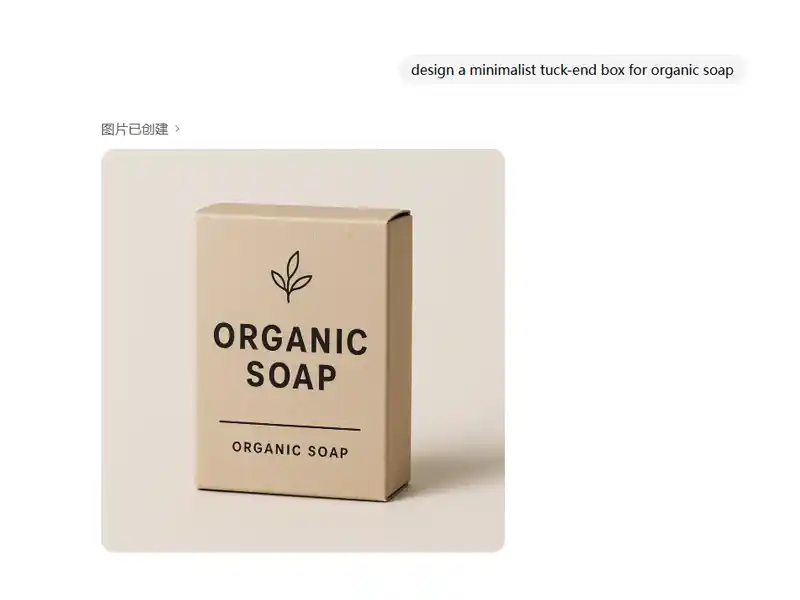
Decide on the physical box shape you plan to use—such as a tuck-end box, drawer box, or mailer box. Then, describe this box type clearly in your AI prompt (e.g., “design a minimalist tuck-end box for organic soap”). This helps the AI generate more accurate and realistic packaging visuals.
✅ Include your brand elements
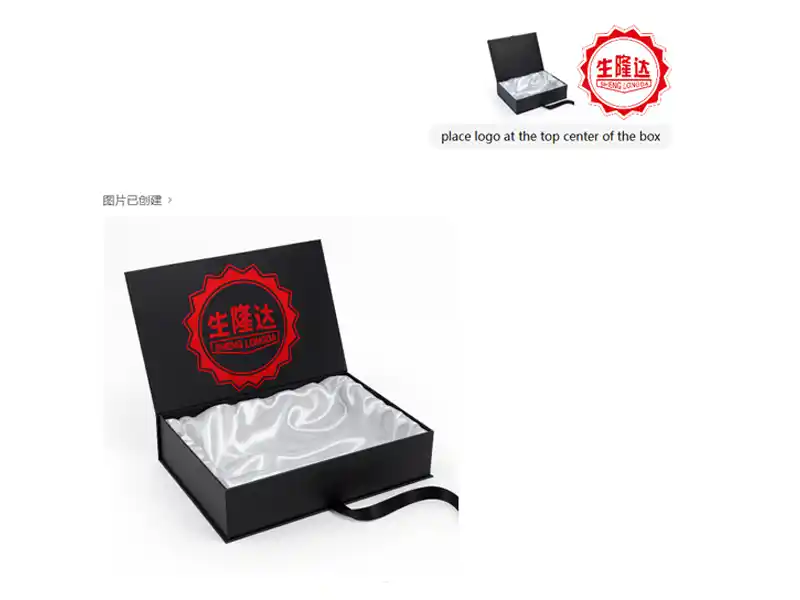
If you want your logo to appear on the box, include it in the AI input. Some platforms allow you to upload the logo directly; for others, you can describe where and how the logo should appear (e.g., “place logo at the top center of the box”).
✅ Be clear with your design goals
Mention the product name, brand tone (e.g., luxurious, eco-friendly, playful), and any specific colors or messages you want included. The more detail you provide, the better the output.
✅ Use AI to inspire—not finalize
Remember, the AI-generated image is only a concept. You’ll still need to work with a packaging designer or supplier to turn it into a functional box that can be produced.
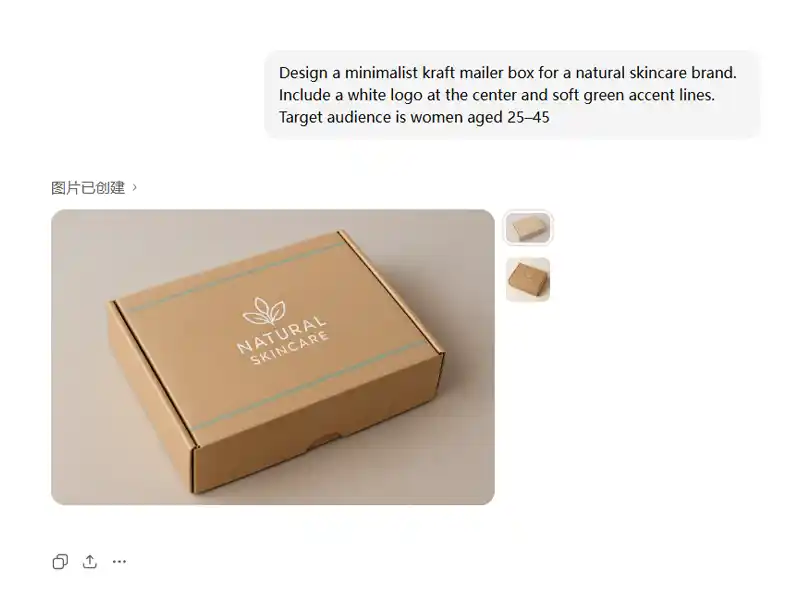
Example Prompt:
“Design a minimalist kraft mailer box for a natural skincare brand. Include a white logo at the center and soft green accent lines. Target audience is women aged 25–45.”
5. The Future of Artificial Intelligence in Packaging Design
AI is evolving rapidly. While it’s currently limited in handling technical details like dielines and material compatibility, future tools may combine creative design with structural engineering.
We’re already seeing early experiments with AI-assisted 3D modeling, and some platforms are working to integrate AI with CAD software. As this technology improves, it may eventually help generate fully functional packaging prototypes.
However, AI will likely remain a support tool, not a full replacement for human packaging experts. The best results will come from a hybrid approach—using AI to spark creativity, and human designers to ensure real-world feasibility.
Conclusion: AI Is an Assistant, Not a Packaging Designer
So, can AI design packaging boxes?
Yes—but only partially.
It’s excellent for exploring creative directions, generating mockups, and assisting with early design concepts. But when it comes to real packaging—box structure, material choices, dielines, and printing—professional experience is still essential.
For startups and small brands, combining AI inspiration with expert support is the smartest and most cost-effective path forward. With design help often included by packaging suppliers, it’s now easier than ever to turn ideas into production-ready boxes—without blowing your budget.