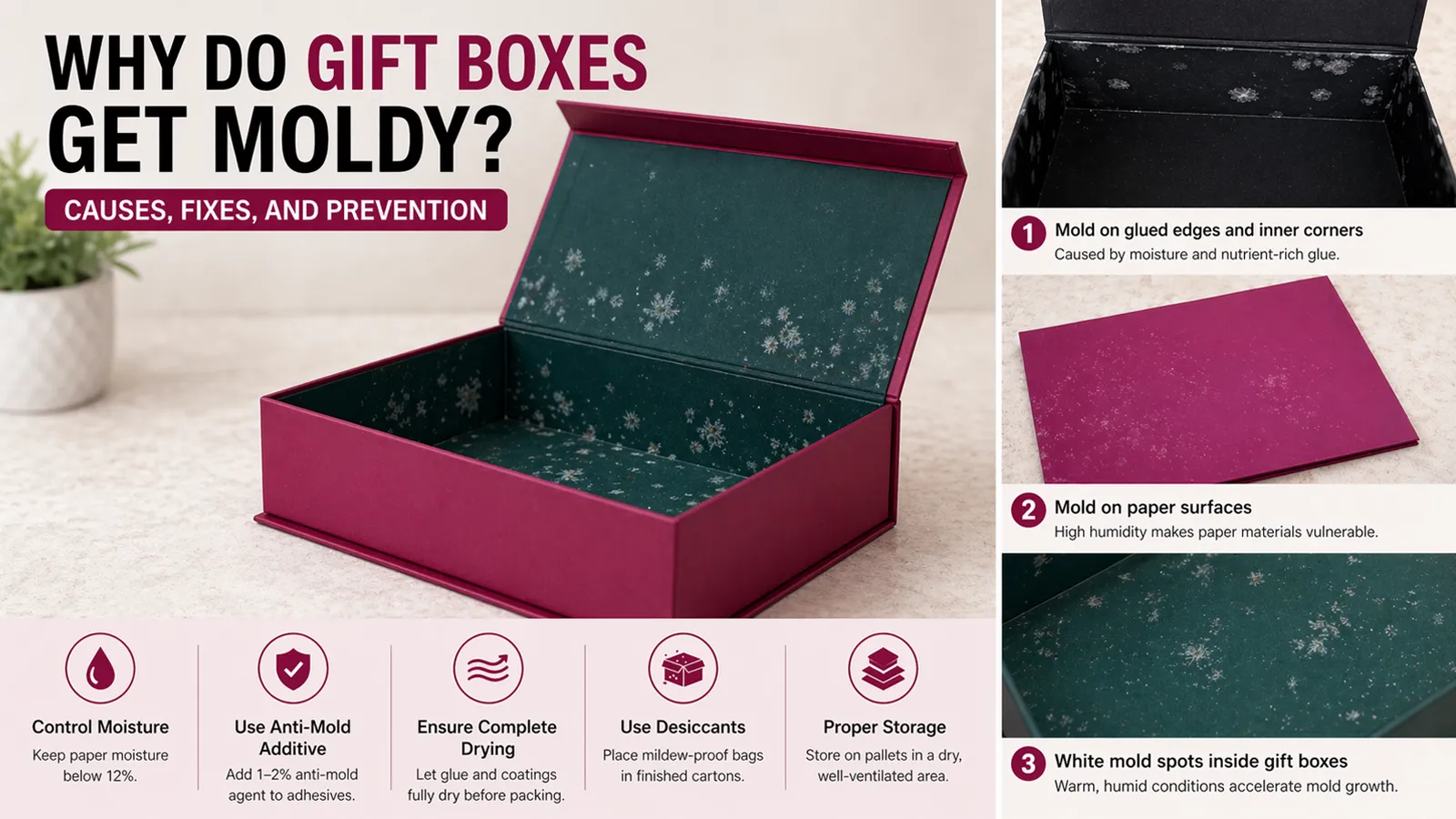
Gift boxes usually get moldy because of three things working together: moisture, nutrients, and warm storage conditions. Paper-based packaging materials, such as grey board, cardboard, corrugated board, and specialty paper, can absorb moisture from the air. Once the moisture level becomes too high, mold has a better chance to grow.
This problem is common in paper packaging because many gift boxes are made from layered materials. A rigid gift box, for example, may include grey board, printed paper, lamination film, white glue, lining paper, and inner trays. If any of these materials contain excess moisture, or if the glue is not fully dry before packing, mold may appear during storage or shipping.
For brands, moldy gift boxes are not just a packaging defect. They can affect product appearance, customer trust, warehouse acceptance, and export inspection. The good news is that most mold problems can be prevented through better material control, glue treatment, drying, storage, and final packing.
Paper and cardboard are organic materials that can support mold growth when moisture is present. The U.S. EPA also notes that mold can grow on organic materials, including paper, when the conditions are suitable.
What Causes Mold on Gift Boxes?
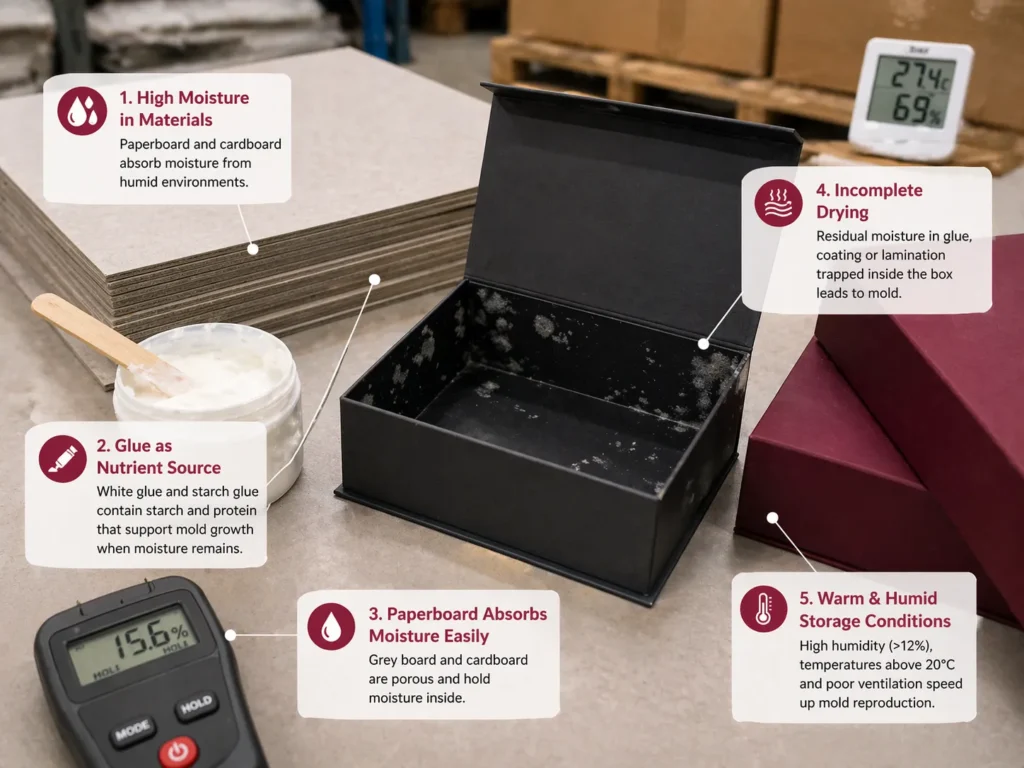
Mold does not usually appear because of one single mistake. In most cases, it comes from a combination of material, production, and storage problems.
1. High Moisture Content in Paper Materials
Moisture is the most important condition for mold growth. Paper materials naturally absorb water from humid air. This is especially true for grey board, cardboard, corrugated board, kraft paper, and uncoated paper.
In packaging production, a practical control target is to keep the moisture content of paper materials and cartons below 12%. When the moisture level exceeds this range, the material may soften, deform, or become more suitable for mold growth.
For example, if warehouse cardboard becomes soft and damp, and testing shows a moisture level of 16%, the risk is already high. Even if the surface still looks clean, the material may contain enough moisture for mold to grow later, especially after the gift boxes are sealed in cartons.
2. Glue Can Become a Nutrient Source
Many gift boxes use white glue, starch glue, or other water-based adhesives. These adhesives are useful because they are easy to apply and suitable for paper bonding. However, some glues contain starch, protein, or other organic substances.
Mold needs nutrients to grow. Glue lines, mounted paper layers, corners, and inner folds can become high-risk areas if the adhesive contains nutrients and is not fully dry. This is why mold often appears first near glued edges, seams, or the bottom of a box.
Environmentally friendly adhesives also need careful control. Some are water-based and may create more moisture inside the box if drying time is too short.
3. Grey Board and Cardboard Absorb Moisture Easily
Grey board is widely used in rigid gift boxes because it is strong, flat, and cost-effective. But it also has a porous structure. This means it can absorb moisture from the air or from nearby damp materials.
Once grey board absorbs moisture, several problems may happen:
- The box may become soft.
- The surface paper may wrinkle.
- Corners may lose shape.
- Glue may dry more slowly.
- Mold risk may increase.
This is especially important for luxury rigid gift boxes, magnetic gift boxes, drawer boxes, and two-piece gift boxes. These products often use thick grey board and multiple glued layers, so moisture trapped inside the structure is harder to release.
SLD Packing’s product range includes rigid gift boxes, foldable cartons, mailer boxes, paper bags, and display packaging, all of which rely on proper paper material control during production and storage.
4. Incomplete Drying During Production
Gift box production usually includes several processes: printing, surface finishing, mounting, die-cutting, folding, gluing, assembly, and packing. Moisture can be introduced at different stages.
Common production-related causes include:
- Ink or coating is not fully dry.
- Lamination is completed before the paper is stable.
- Water-based glue is applied too heavily.
- Finished boxes are stacked too tightly.
- Boxes are packed into cartons too soon.
- Cartons are sealed before internal moisture escapes.
This problem is easy to overlook. A gift box may look finished on the outside, but the inner glue line or mounted layer may still contain moisture. Once the box is sealed in a carton, the moisture has nowhere to go.
5. Warm and Poorly Ventilated Storage Conditions
Mold grows faster in warm, humid, and poorly ventilated environments. Temperatures above 20°C can speed up mold reproduction when moisture and nutrients are also present.
Warehouses with poor airflow are especially risky during rainy seasons or in tropical climates. If cartons are placed directly on the floor or close to damp walls, paper materials may absorb moisture over time.
Sealed cartons can also trap moisture. During long-distance shipping, temperature changes may cause condensation inside cartons or containers. Desiccants are commonly used in packaging to absorb excess moisture and reduce mold risk in enclosed packaging environments.
Quick Diagnosis: Where Is the Mold Problem Coming From?
The table below can help packaging buyers, factories, and warehouse teams quickly identify the possible cause.
| Mold Sign | Possible Cause | What to Check |
|---|---|---|
| Mold appears near glued edges | Adhesive not fully dry or glue contains nutrients | Glue type, glue amount, drying time, stacking pressure |
| Mold appears on large paper surfaces | Paperboard moisture is too high | Material moisture content, warehouse humidity, storage time |
| Box feels soft or warped | Paper absorbed moisture | Floor contact, wall distance, ventilation, pallet use |
| Mold appears after shipping | Moisture trapped in sealed packaging | Carton sealing, container humidity, desiccant use |
| Mold appears on stored raw materials | Poor workshop hygiene or damp storage | Turnover boxes, dust control, material covering |
| Mold appears inside the gift box | Moisture trapped during assembly | Inner lining, inserts, glue lines, drying process |
How to Fix Moldy Gift Boxes Immediately
Once mold is found, the first step is to stop it from spreading. Do not mix affected boxes with clean products or raw materials.
1. Separate Affected Boxes
Move moldy gift boxes away from finished goods, paper stock, glue, and semi-finished products. Mold spores can spread through air, dust, hands, and tools. Keep the affected batch in a separate inspection area.
Do not repack moldy boxes into clean cartons. This may contaminate the whole batch.
2. Check the Moisture Content
Use a moisture tester or mold prevention tester to check the moisture content of the paperboard, cartons, and affected boxes. If the reading is above 12%, treat the batch as high risk.
Testing should include:
- Grey board
- Printed paper
- Cartons
- Inner trays
- Glued areas
- Materials stored near walls or floors
Do not only test the surface. Mold risk often starts inside the structure, especially in thick rigid boxes.
3. Inspect Glue Lines and Hidden Corners
Mold often grows first in places where moisture dries slowly. Check the following areas carefully:
- Box corners
- Bottom folds
- Inner lining paper
- Mounted layers
- Magnetic closure areas
- Drawer box sliding parts
- Inserts and dividers
- Carton sealing areas
If the mold is concentrated near glue lines, the problem may be related to adhesive formulation, glue amount, or drying time.
4. Improve Airflow and Dehumidification
Move the affected batch to a dry, ventilated area. Use dehumidifiers if the warehouse is humid. Avoid direct sunlight if it may deform the box or damage printing, but make sure air can circulate around the cartons.
For unopened cartons, check whether the inside has a musty smell. If moisture is trapped inside, open and inspect the carton before deciding whether the goods can be accepted, reworked, or rejected.
5. Decide Whether the Boxes Can Still Be Used
This depends on the product type and the severity of mold.
For luxury packaging, cosmetics, food-related packaging, jewelry boxes, and gift packaging for export, moldy boxes are usually not acceptable. Even small mold spots can affect brand image and customer trust.
If the mold is heavy, has entered the paper layers, or has a strong smell, replacement is usually safer than cleaning. Paper packaging is porous, so surface cleaning may not remove the problem completely.
Gift Box Mold Prevention Solutions
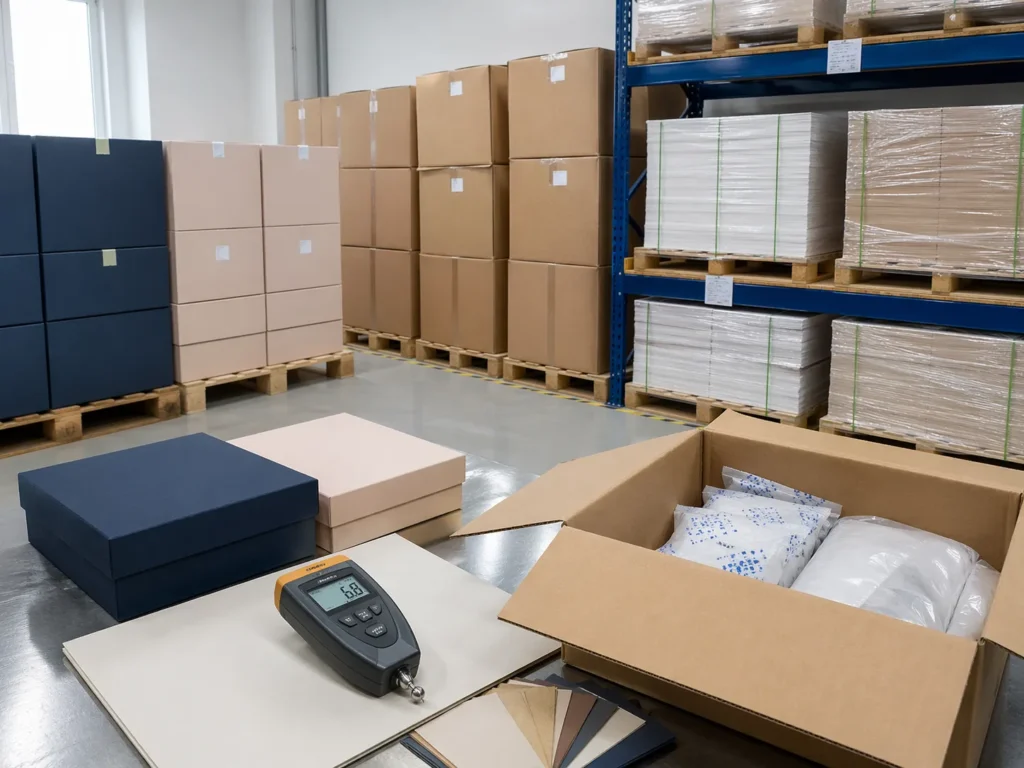
Prevention is much easier than correction. The best approach is to control mold risk from raw material storage to finished product packing.
1. Keep Paper Materials Clean and Hygienic
Paper materials should be stored in a clean and dry area. Workshop turnover boxes should also be kept clean and tidy.
For raw materials not used on the same day, cover the turnover boxes with cloth or plastic film to reduce dust and moisture exposure. Dust can carry mold spores and organic particles, which may increase contamination risk.
Semi-finished products should not be placed directly on the ground. Use pallets, racks, or clean shelves to isolate them from floor moisture.
For special materials or high-risk orders, mold risk testing can be arranged before mass production. This is useful for packaging shipped to humid regions or stored for a long time.
2. Control Paper and Carton Moisture Below 12%
Moisture control is the core step in gift box mold prevention. Paper materials, cartons, and semi-finished packaging should be tested before production and before final packing.
Recommended actions:
- Test material moisture before use.
- Keep paper and carton moisture below 12%.
- Check warehouse materials after rainy or humid weather.
- Wrap long-term unused materials with plastic film.
- Avoid placing materials near doors, windows, wet walls, or floors.
- Use pallets to keep cartons away from ground moisture.
A common warning sign is softened cardboard. If the cardboard feels damp or loses stiffness, test it immediately. On-site testing may show readings such as 16%, which indicates a high risk of mold growth.
3. Add Anti-Mold Agent to Adhesives
Adhesives are one of the most important control points. White glue, starch glue, and water-based glue may provide nutrients for mold if they are not protected.
For adhesives, especially environmentally friendly adhesives, add 1–2% KP-M24 adhesive anti-mold agent before use. This helps reduce the chance that glue becomes a nutrient source for mold and microorganisms.
When adding anti-mold agents, factories should control:
- Dosage
- Mixing uniformity
- Glue storage time
- Glue container cleanliness
- Compatibility with paper and printing finishes
Do not add anti-mold agent randomly. It should be tested with the actual glue, paper, and production process before bulk use.
4. Ensure Complete Drying Before Packaging
Finished gift boxes should not be packed immediately after gluing if moisture has not fully evaporated. This is especially important for thick rigid boxes, handmade boxes, boxes with inner lining, and boxes using large glue areas.
Practical drying controls include:
- Extend drying time in humid weather.
- Avoid stacking boxes too tightly after gluing.
- Use airflow to help moisture escape.
- Check hidden glue areas before sealing cartons.
- Do not rush packing after lamination or mounting.
- Increase inspection for urgent orders.
Rushing the drying process is one of the most common causes of mold after shipment. The box may pass visual inspection in the factory but become moldy after several weeks in a sealed carton.
5. Place Mildew-Proof Bags Inside Finished Cartons
Finished gift boxes are often sealed in export cartons. Once sealed, the carton becomes a closed environment. If moisture remains inside, mold risk increases during storage and shipping.
Place a mildew-proof bag or desiccant inside the finished product packaging carton. This helps absorb excess moisture and reduce humidity inside the sealed carton.
This step is especially recommended for:
- Sea freight
- Long-distance shipping
- Humid climates
- Rainy season production
- Long-term warehouse storage
- Luxury gift boxes
- Cosmetic packaging
- Food-related outer packaging
Desiccants are widely used to control moisture in packaging and shipping environments, especially where condensation or trapped humidity may damage products.
6. Store Boxes on Pallets or Material Racks
Never place gift boxes, cartons, or semi-finished products directly on the floor. Concrete and tiled floors can transfer moisture into paper packaging, especially in humid warehouses.
Good storage habits include:
- Use pallets or shelves.
- Keep cartons away from walls.
- Leave space for air circulation.
- Avoid over-stacking damp cartons.
- Keep storage areas clean.
- Monitor humidity regularly.
- Use dehumidifiers in wet seasons.
This simple step can prevent many moisture-related packaging problems.
Gift Box Mold Prevention Checklist
Use this checklist during material storage, production, and final packing.
| Stage | Control Point | Recommended Action |
|---|---|---|
| Raw material storage | Paper moisture | Keep paper and cartons below 12% moisture |
| Workshop handling | Cleanliness | Cover unused materials with cloth or plastic film |
| Semi-finished goods | Ground contact | Use pallets, racks, or shelves |
| Adhesive preparation | Glue mold risk | Add 1–2% KP-M24 adhesive anti-mold agent |
| Production | Drying time | Make sure glue, coating, and mounted layers are fully dry |
| Finished packing | Sealed carton humidity | Place mildew-proof bags or desiccants inside cartons |
| Warehouse storage | Airflow and humidity | Improve ventilation and use dehumidifiers if needed |
| Long-term storage | Dust and moisture | Wrap materials with plastic film and inspect regularly |
| Shipping | Container moisture | Use moisture protection for humid routes or sea freight |
Common Mistakes That Increase Mold Risk
Many mold problems come from small mistakes repeated during production or storage. Here are the most common ones:
- Packing boxes before the glue is fully dry
- Storing paperboard directly on the floor
- Ignoring warehouse humidity during rainy seasons
- Using water-based glue without anti-mold treatment
- Sealing finished boxes without mildew-proof bags
- Leaving raw materials uncovered in dusty workshops
- Stacking semi-finished products too tightly
- Using damp cartons for final packing
- Not testing paper moisture before production
- Treating mold as only a surface problem
The key point is simple: mold prevention must be built into the process. It cannot rely only on final inspection.
FAQ About Mold on Gift Boxes
Can moldy gift boxes still be used?
Usually, moldy gift boxes should not be used for retail, luxury, cosmetic, food-related, or export packaging. Paper is porous, so mold may enter the material instead of staying only on the surface. Even if the visible mold is cleaned, the smell or hidden contamination may remain.
What moisture level is safe for paper gift boxes?
A practical factory control target is to keep paper materials and cartons below 12% moisture content. If the reading is higher than 12%, the material should be treated as a potential mold risk, especially in warm or humid conditions.
Why do gift boxes get moldy after shipping?
Gift boxes may get moldy after shipping because moisture is trapped inside sealed cartons. If the glue, paperboard, or carton is not fully dry before shipment, the moisture may remain inside. During sea freight or long-distance transport, temperature changes can also create condensation.
Does lamination prevent mold?
Lamination can help reduce moisture contact on the printed surface, but it does not completely prevent mold. If moisture is already trapped inside the grey board, glue layer, or inner lining, mold can still grow from the inside.
Should every gift box carton include a mildew-proof bag?
For normal short-term local delivery, it may not always be necessary. But for humid climates, rainy seasons, sea freight, long-term storage, and export packaging, adding a mildew-proof bag or desiccant is a practical and low-cost prevention step.
Why does mold often appear near the glued parts of a box?
Glue areas dry more slowly than exposed paper surfaces. Some adhesives also contain starch, protein, or organic ingredients that may support microbial growth. If the glue is water-based and the box is packed too early, mold is more likely to appear near glued edges or corners.
Conclusion
Gift boxes get moldy when moisture, nutrients, and warm storage conditions appear together. Paperboard absorbs moisture easily, glue may provide nutrients, and sealed cartons can trap humidity during storage or shipping.
The most effective solution is not one single step. A reliable mold prevention process should include:
- Clean material handling
- Paper moisture control below 12%
- Proper adhesive treatment
- Complete drying before packing
- Pallet or rack storage
- Good ventilation
- Mildew-proof bags in finished cartons
For paper packaging such as rigid gift boxes, folding cartons, mailer boxes, display boxes, and paper bags, mold prevention should start before production and continue until the finished cartons are shipped. This protects the packaging appearance, product value, and customer experience.