
The best custom Advent calendar packaging begins with the products inside—not the Christmas artwork outside. Product dimensions, weight, fragility, food-contact status, assortment sequence, retail channel, and shipping method should determine the structure. Once those requirements are clear, the graphics and finishes can turn the functional package into a memorable seasonal experience.
Start With a Complete Product Map
Before choosing a box style, create a product map covering every item in the calendar. Do not assume that one compartment can be repeated 24 times unless the products are genuinely identical in size and weight.
For each item, record:
- Final packaged dimensions
- Weight
- Orientation inside the calendar
- Fragility or leakage risk
- Whether the item is individually wrapped
- Whether any packaging component will touch food directly
- Preferred opening date and position
- Required label visibility
- Any separation requirements
This information determines the cavity dimensions, board thickness, tray geometry, opening direction, and overall calendar size. It also reveals whether a regular grid is practical or whether the design needs mixed-size drawers.
Allow appropriate clearance around each product. A cavity that is too tight can make the item difficult to remove, while excessive space allows movement and can make the calendar feel poorly engineered.
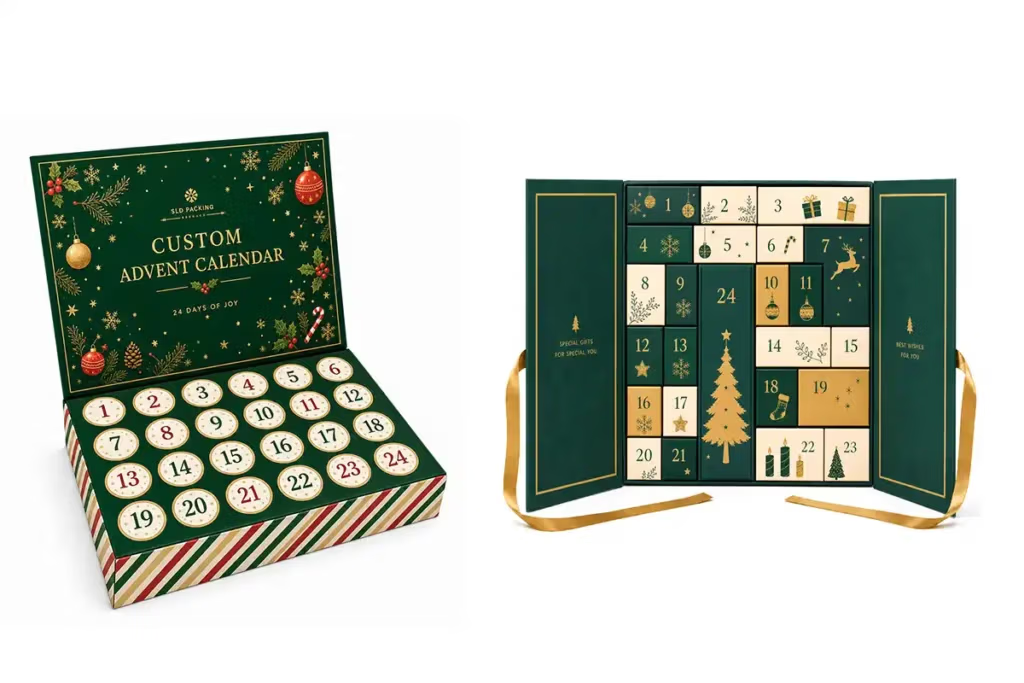
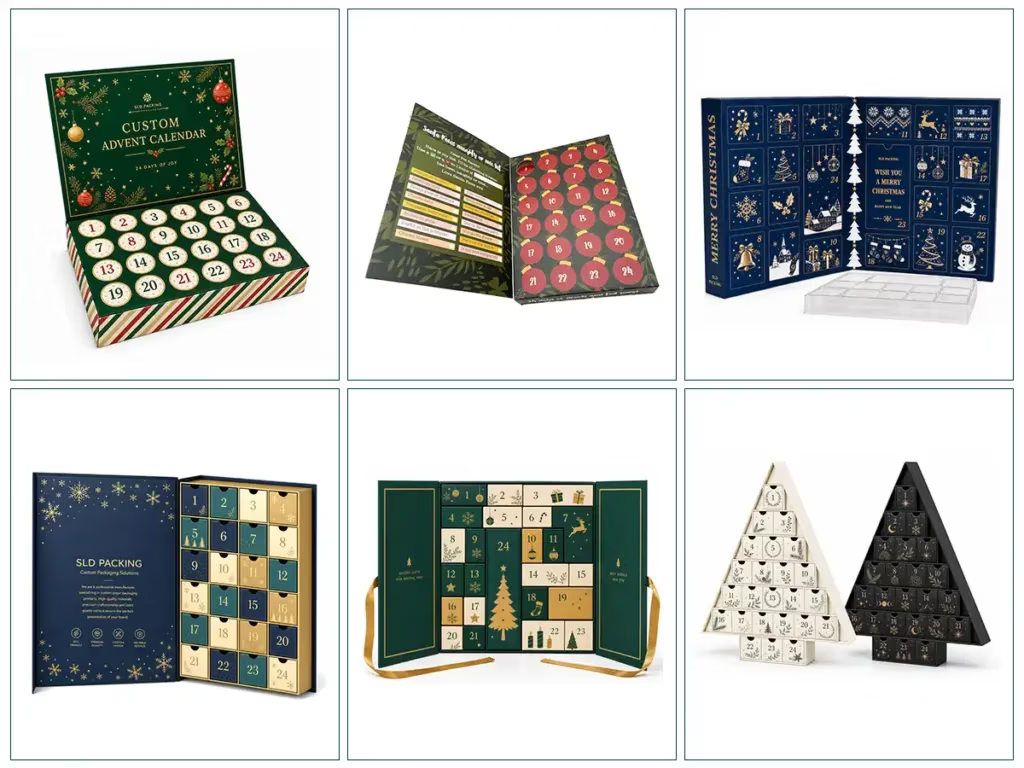
Compare the Main Advent Calendar Structures
The right structure depends on the product assortment, positioning, logistics, and customer experience.
| Structure | Best suited to | Main advantages | Points to evaluate |
|---|---|---|---|
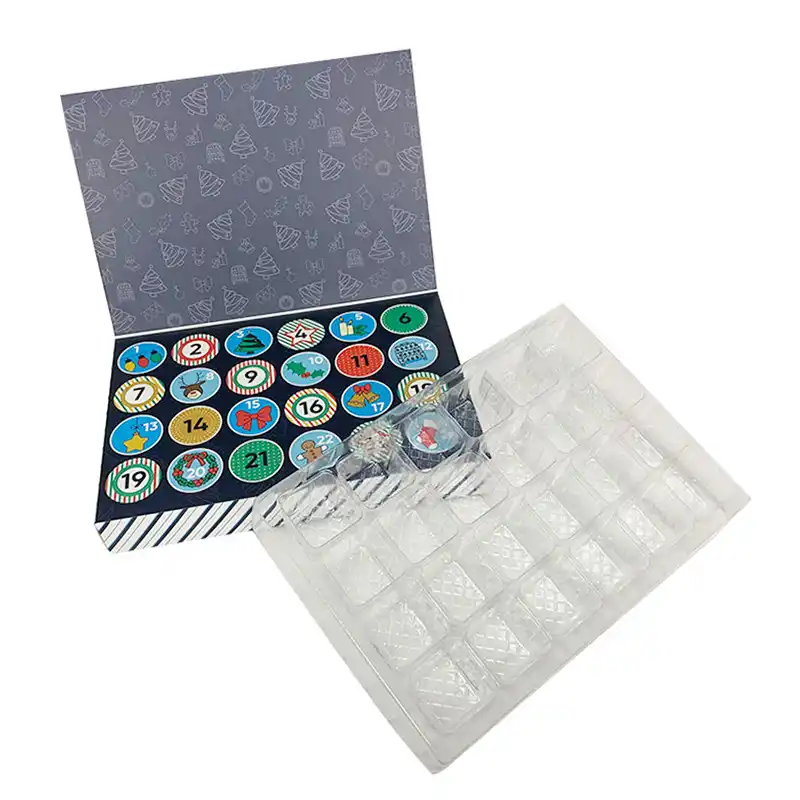
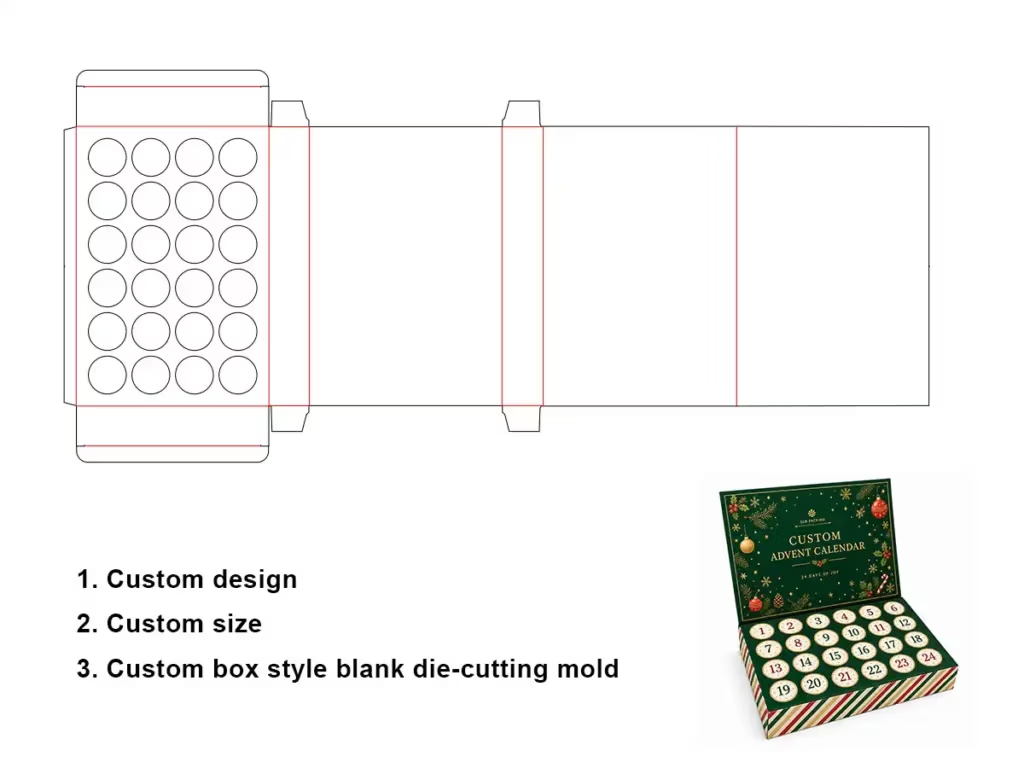
| Perforated doors with a cavity tray | Chocolates, candies, samples, and other small uniform items | Familiar countdown experience, compact format, efficient use of space | Door tear quality, tray tooling, food-contact requirements, and material separation |
| Book-style rigid box | Beauty products, premium confectionery, gifts, and branded collections | Large artwork area, strong presentation, satisfying opening experience | Weight, hinge durability, closure design, and shipping volume |
| Double-door cabinet with drawers | Mixed-size cosmetics, accessories, tea, gifts, and premium assortments | Flexible compartment sizes and a reusable appearance | Component count, assembly complexity, drawer fit, and overall cost |
| Folding carton with individual inner boxes | Lightweight products and campaigns requiring efficient storage | Lower weight, easier flat storage for some designs, flexible graphics | Assembly time, stacking strength, and product retention |
| Shaped display calendar | High-impact retail displays and collectible gift sets | Distinctive shelf presence and strong seasonal identity | Stability, protective shipping carton, material use, and packing efficiency |
A premium structure is not automatically the best choice. A rigid double-door calendar can be appropriate for a high-value beauty launch, while a compact carton-and-tray format may serve chocolates more efficiently. The structure should support the product’s value and sales channel without creating unnecessary weight or empty space.
SLD Packing’s custom Advent calendar packaging options include customizable structures, dimensions, printing, and inserts. The final configuration should still be developed around the confirmed product assortment.
Engineer the Compartments Before Finalizing the Artwork
The numbered doors are the most visible feature, but the system behind them determines whether the calendar works.
Choose a Logical Opening Sequence
A strict left-to-right sequence is easy to understand, but a scattered sequence can make the daily search more playful. In either case:
- Keep every number legible at normal viewing distance.
- Avoid placing numbers across folds, thumb notches, or perforations.
- Check contrast after applying foil, lamination, or textured paper.
- Make the final compartment visually significant only if the product assortment supports it.
- Confirm whether the campaign needs 12, 24, 25, or another number of openings.
The hidden product should not be visible through neighbouring doors. Internal walls, tray geometry, or individual cartons may be needed to prevent premature discovery.
Design Doors and Drawers for Real Use
Perforated doors need a balance between security and opening force. If the cuts are too weak, doors may open during packing or transit. If they are too strong, customers may damage the printed surface while trying to reach the product.
For drawer calendars, review:
- Finger-notch size
- Drawer clearance
- Resistance to accidental sliding
- Printed-number alignment
- Strength when heavier products are placed in upper compartments
A physical prototype is much more useful than a screen rendering for evaluating these details.
Select Inserts According to the Product
The insert keeps products organized and affects protection, presentation, packing speed, and end-of-life disposal.
| Insert option | Appropriate applications | Important considerations |
|---|---|---|
| Thermoformed cavity tray | Chocolates, confectionery, small bottles, capsules, and uniform products | Resin selection, tooling, food-contact status, cavity release, and recyclability |
| Paperboard dividers or platforms | Wrapped foods, accessories, stationery, and lightweight gifts | Edge strength, movement control, fold direction, and assembly |
| Individual paper drawers or mini boxes | Mixed-size beauty products, gifts, samples, and collectibles | Component count, packing labor, fit consistency, and material use |
| Molded pulp | Selected non-food or suitably protected products | Surface finish, dimensional tolerance, moisture sensitivity, and product compatibility |
| Foam insert | Fragile or premium non-food items requiring close retention | Material compatibility, disposal route, odor, and sustainability objectives |
A “plastic-free” structure is possible for many products, but it is not automatically suitable for every calendar. Small, oily, fragile, or unwrapped products may require a barrier or precisely formed cavity. Compare the complete system rather than replacing one material without checking protection and packing performance.
For mixed-size assortments, individual paper drawers often provide more flexibility than one molded tray. For products with consistent dimensions, a cavity tray can reduce movement and keep the calendar shallower.
Balance Seasonal Impact With Production Practicality
Advent calendars invite decorative finishes, but every finish should have a clear visual purpose. Common options include foil stamping, embossing, spot gloss effects, printed patterns, matte lamination, and soft-touch surfaces.
A restrained finish strategy often produces a more premium result than applying multiple effects everywhere. For example, foil can emphasize the brand name and calendar numbers while printed illustrations carry the broader seasonal theme.
During artwork development, check:
- Dieline orientation on doors, flaps, drawers, and interior panels
- Safe distances from cuts, creases, perforations, and thumb notches
- Number accuracy and sequence
- Color consistency across separate components
- Registration tolerance for foil, embossing, and spot effects
- Barcode, recycling, warning, and product-information areas
- The appearance of the calendar in both closed and open positions
SLD Packing’s custom packaging services cover structural guidance, printing finishes, and insert development. Supplying final product samples or accurate three-dimensional product data will make that development more reliable.
Address Food Contact and Market Requirements Early
Compliance cannot be added as a final artwork correction. The destination market, product type, and exact contact layers must be identified before materials are approved.
Calendars Containing Food
For chocolates, candies, tea, snacks, or other edible products, determine whether the food is:
- Unwrapped and in direct contact with a tray, cup, liner, or paper surface
- Individually sealed before being placed in the calendar
- Fatty, dry, acidic, moist, or otherwise demanding for the contact material
- Stored at room temperature, refrigerated, or under another condition of use
In the EU, food-contact materials must comply with Regulation (EC) No 1935/2004 and applicable good manufacturing practice and material-specific rules. The European Commission’s food-contact materials guidance provides the regulatory framework.
In the United States, the regulatory status of a food-contact component depends on the substance, intended food type, and conditions of use. The FDA’s food packaging and food-contact substance resources explain the relevant authorization routes and inventories.
Request documentation for the exact tray, liner, adhesive, coating, ink system, and use condition where applicable. A generic statement that a material is “food grade” is not a substitute for market- and application-specific evidence.
Packaging and Sustainability Requirements
The EU Packaging and Packaging Waste Regulation generally began applying on August 12, 2026, with additional requirements introduced in phases. It places increasing emphasis on packaging minimization, recyclability, substances of concern, and supporting documentation. Several major design requirements apply from 2030. Brands selling into the EU should therefore review new calendar structures against the current PPWR framework rather than relying on previous packaging assumptions.
For an Advent calendar, practical design questions include:
- Can unnecessary empty space be removed?
- Does each layer perform a protective, containment, hygiene, logistics, or usability function?
- Can major components be separated after use?
- Are mixed materials necessary for product performance?
- Are material and disposal claims supported in the destination market?
- Can the design achieve the required experience with less weight or fewer components?
Avoid vague claims such as “100% eco-friendly.” Use specific, supportable descriptions of materials, sourcing, recycled content, separability, or disposal routes.
Approve a Functional Prototype, Not Just a Printed Sample
A color proof can confirm artwork, but it cannot validate the entire calendar. Before mass production, evaluate a representative structural prototype containing the actual products or accurate product dummies.
The review should include:
- Product fit: Each item can be inserted and removed without damage.
- Retention: Products remain in their assigned compartments when the calendar is lifted, tilted, or handled.
- Opening performance: Doors tear cleanly, drawers slide correctly, and closures remain secure.
- Structural balance: The calendar stands or opens safely when compartments contain different weights.
- Artwork alignment: Numbers, graphics, foil, and cuts remain correctly positioned.
- Packing process: Products can be loaded in the correct sequence without unreasonable handling.
- Transit protection: The calendar and its outer shipping carton are evaluated for the intended distribution route.
- User experience: Instructions are clear and products are accessible without exposing neighbouring compartments.
Any change to product dimensions, insert material, board thickness, or finish can affect the approved structure. Freeze the product assortment before finalizing tooling and production artwork whenever possible.
Prepare a Complete Request for Quotation
A useful quotation request should describe the project well enough for the supplier to recommend a structure and identify cost variables. Include:
- Target quantity
- Destination country and delivery location
- Required arrival date
- Number of compartments
- Dimensions and weight of every product
- Photos or physical samples of the products
- Food-contact or other compliance requirements
- Preferred structure or reference images
- Flat and assembled size limitations
- Printing colors and desired finishes
- Insert preference
- Retail, e-commerce, or promotional distribution channel
- Packing responsibilities
- Required testing or documentation
- Artwork status
If the structure is still undecided, provide the product map and desired positioning instead of guessing at final box dimensions. This gives the packaging team a better basis for proposing an efficient design.
Build the Calendar Around the Experience You Want to Deliver
A strong Advent calendar creates anticipation without sacrificing protection, usability, or production control. Start with the assortment, choose a structure that fits the products, simplify materials where practical, and validate the complete pack before production.
To discuss a project, send your product dimensions, compartment count, reference images, target market, quantity, and required delivery date through the SLD Packing contact page.