When international oil prices rise, many packaging buyers ask the same question: will box prices rise too?
The short answer is yes, they can. But in most cases, the increase is not immediate and not one-to-one. Oil usually affects packaging costs through freight, chemical inputs, and energy-related production costs first. Only after those pressures continue for a period of time do they begin to show up more clearly in finished box quotations. EIA says crude oil is the largest component of diesel prices, and its latest outlook also says higher crude prices are lifting diesel prices in 2026.
That matters because a paper box is not just paper. A finished custom box may include paperboard, printing ink, adhesive, lamination, foil stamping, converting, packing, and shipping. SLD Packing’s factory profile also shows a custom paper packaging workflow built around printing and finishing equipment, which is a good reminder that box pricing is shaped by several cost layers, not by raw paper alone.
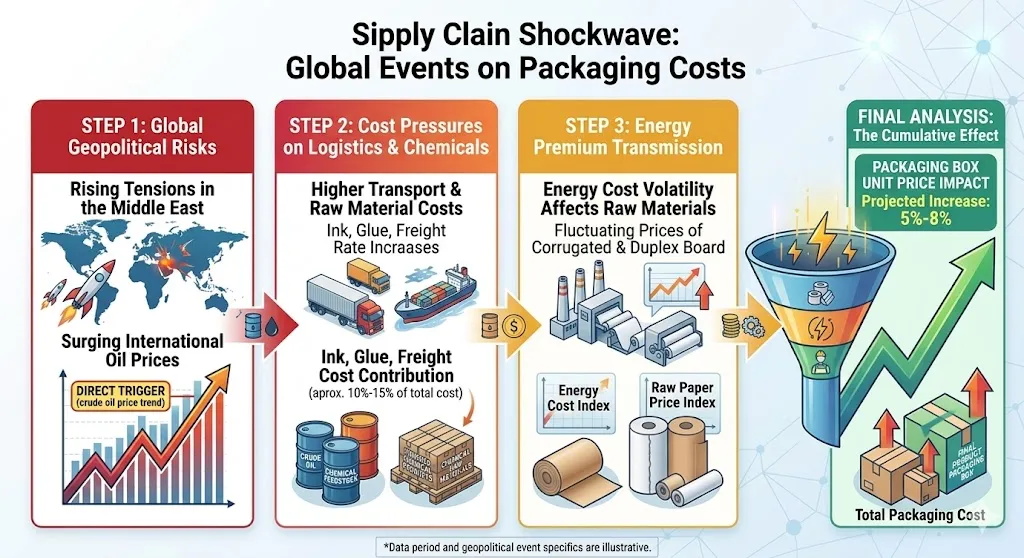
How oil price increases usually move through packaging costs
| Stage | What changes first | Why it matters for packaging | What buyers may notice |
|---|---|---|---|
| Stage 1: Oil rises | Crude oil and diesel markets react | Diesel is a major transport cost driver, and crude oil is the biggest component of diesel pricing | No immediate box increase, but risk starts building |
| Stage 2: Freight and chemical inputs rise | Transport, ink-related chemicals, and some adhesive or coating inputs face pressure | Oil and petrochemical pricing can influence feedstocks such as naphtha and LPG, while printing inks also use petrochemical-based raw materials | Suppliers may shorten quote validity or warn of cost volatility |
| Stage 3: Production and box quotes adjust | Mills and converters pass through higher costs | Paper manufacturing is energy intensive, and long-lasting cost pressure can move into converted packaging prices | Unit prices, freight surcharges, or MOQs may change |
This three-step pattern is based on current EIA data on diesel and petrochemical feedstocks, printing-ink industry information on petrochemical-based raw materials, and AF&PA material on energy use in paper manufacturing.
Why higher oil prices can raise packaging box costs
1. Freight usually feels the pressure first
Freight is often the first cost line to move. EIA says crude oil accounted for about 51% of the monthly average U.S. retail on-highway diesel price from 2004 through 2025. Its latest Short-Term Energy Outlook also says higher crude prices are pushing diesel higher, with the U.S. average retail diesel price forecast to rise above $5.80 per gallon at its 2026 peak. For packaging buyers, that matters because paperboard, print materials, and finished cartons all need to be transported.
2. Some packaging inputs are linked to petrochemical markets
Oil does not just affect trucks. EIA notes that the relative prices of crude oil, petrochemical products, and petrochemical feedstocks can influence naphtha and LPG pricing. At the same time, the European Printing Ink Association states that today’s printing ink industry uses both renewable and petrochemical-based raw materials. In practical terms, this means oil market volatility can create cost pressure for some inks and other oil-linked chemical inputs used in packaging production.
3. Paper and board production also depend on energy
Higher oil prices do not automatically mean higher board prices the next day, but energy costs still matter. AF&PA says pulp and paper manufacturing is energy intensive, and energy represents one of the most significant costs for mill operations. It also notes that purchased energy is one of the largest operating costs in the paper and wood products industry. When energy and transport stay high for long enough, mills and converters have less room to absorb those costs.
Does every packaging box go up when oil rises?
No. That is where many simplified articles get it wrong.
A custom packaging quote depends on much more than oil. Material grade, box size, structure, print coverage, surface finish, insert type, assembly work, order quantity, and shipping destination all affect the final price. A plain corrugated mailer and a rigid gift box with foil stamping and hand assembly do not react in the same way to cost changes. Based on SLD Packing’s public product profile, custom rigid boxes, foldable cartons, and mailer boxes involve different production paths and finishing steps, so their pricing sensitivity is naturally different as well.
Timing matters too. Suppliers may have old paper stock, fixed freight arrangements, or short-term chemical inventory. That is why a sharp oil move this week does not always turn into a higher box quote this week. Inference-wise, the more accurate view is that oil creates pressure in the system first, and pricing changes appear later if the pressure continues. That interpretation is supported by the current EIA cost chain and by BLS producer price data for box manufacturing.
What the data suggests about finished box prices
BLS data shows that the producer price index for corrugated and solid fiber box manufacturing rose from 447.616 in February 2025 to 465.332 in February 2026. That is roughly a 4.0% increase over that period. This does not prove oil alone caused the increase, but it does show that finished box prices can move upward during a period when freight and input costs are under pressure.
What buyers can do before costs rise further
The best response is not panic buying. It is better planning.
First, check which part of your packaging cost is most exposed. If freight is the main concern, shipment planning and order consolidation may help. If the bigger cost sits in printing and finishing, simplifying heavy ink coverage, complex coatings, or non-essential decorative processes may protect the budget better than changing the board itself.
Second, lock specifications early where possible. Frequent size or artwork changes create extra sampling, setup, and waste. In a volatile market, stable specifications usually help keep quotes more stable too.
Third, ask suppliers how long a quote is valid and which cost area is changing the fastest. Buyers do not need a full internal costing formula, but knowing whether pressure is coming from freight, board, or finishing makes decisions much easier.
Final thought
So, is your packaging box about to take off when oil prices surge?
Possibly, but usually not overnight. Oil price increases tend to move through the packaging supply chain in stages: freight first, chemical inputs next, and finished box pricing later if the pressure lasts. For buyers, the smarter move is to watch the full chain instead of focusing only on crude oil headlines. That gives a more realistic view of when packaging prices may actually change.