
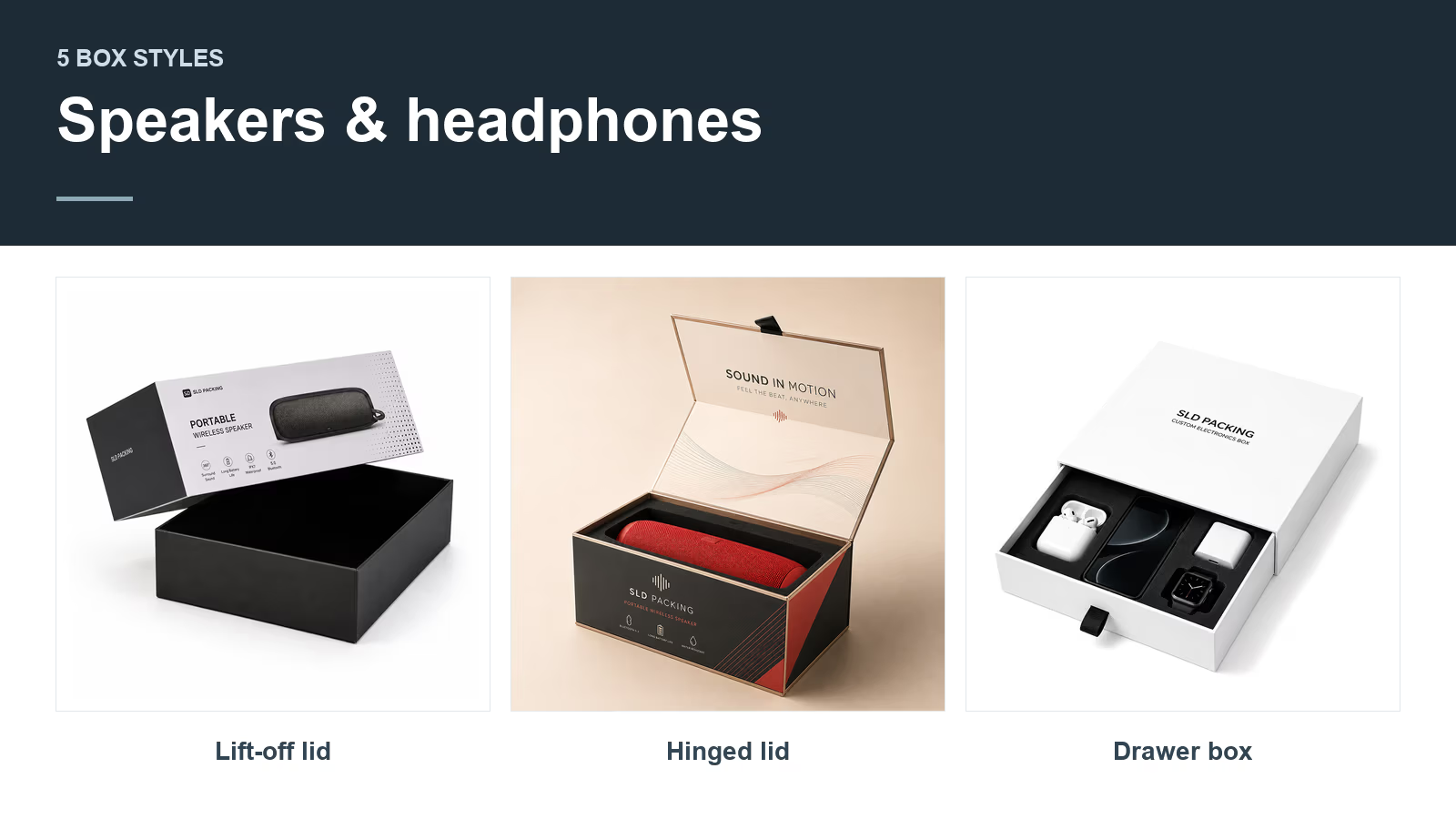
Start with a tuck-top carton for a compact audio product headed for retail shelves, or a corrugated mailer for a product that will ship by parcel. For premium presentation, choose a two-piece lift-off lid when the whole product should be visible at once, a book-style hinged lid when the inside cover has a job to do, or a drawer when you want to reveal a compact kit in stages.
The same speaker can work in several of these boxes. What changes is how you load it, where the insert supports it, and how the buyer takes it out. A speaker with a protruding handle and a pair of headphones with swiveling ear cups can both fit on paper and still be awkward to pack or remove.
Compare the five box styles
| Box style | Where it fits | What to check on a loaded sample |
|---|---|---|
| Two-piece lift-off lid | Premium speakers and over-ear headphones | Lid fit and room to lift out the product |
| Tuck-top retail carton | Compact speakers, earbuds and entry-level headsets | Bottom support and flap clearance |
| Book-style hinged lid | Flagship audio products and launch kits | Opening angle and clearance at the hinge |
| Drawer box | Earbuds, compact headsets and accessory bundles | Pull resistance and clearance inside the sleeve |
| Corrugated mailer | Direct-to-consumer parcels or an outer box for a retail pack | Product movement, closure and protection in transit |
1. Two-piece lift-off lid box
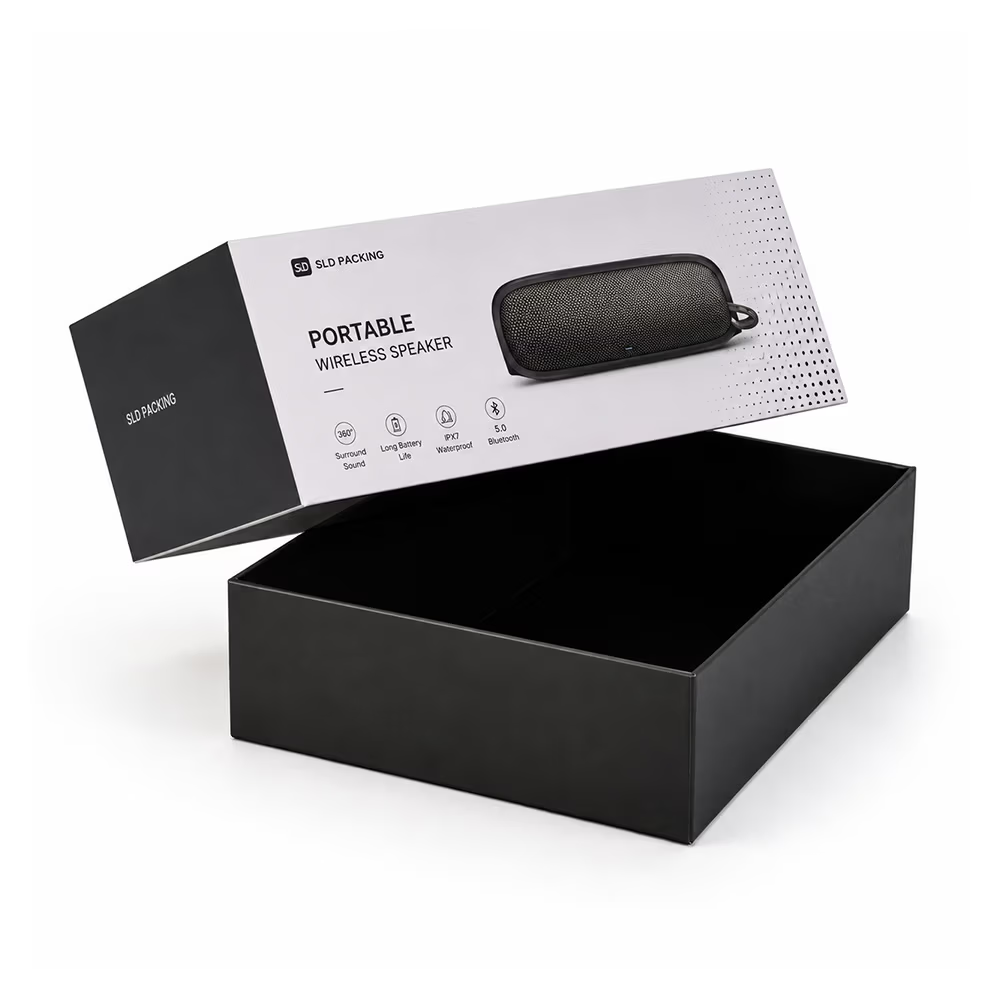
A two-piece rigid box makes sense for a portable speaker or a pair of over-ear headphones you want the buyer to see all at once. Lifting off the lid exposes the full opening. A wide speaker or a headset in a travel case can then lift straight out if the insert leaves enough finger room at the grip points.
Check the lid fit after the box is wrapped and loaded. A close fit can feel deliberate, but too much resistance can make the buyer lift the base with the lid. For a heavier speaker, try lifting the unit from its intended grip points while the base sits on a table. A deep, snug recess can keep the speaker in place and still make it hard to remove. This is a useful first check for two-piece rigid boxes.
2. Tuck-top retail carton
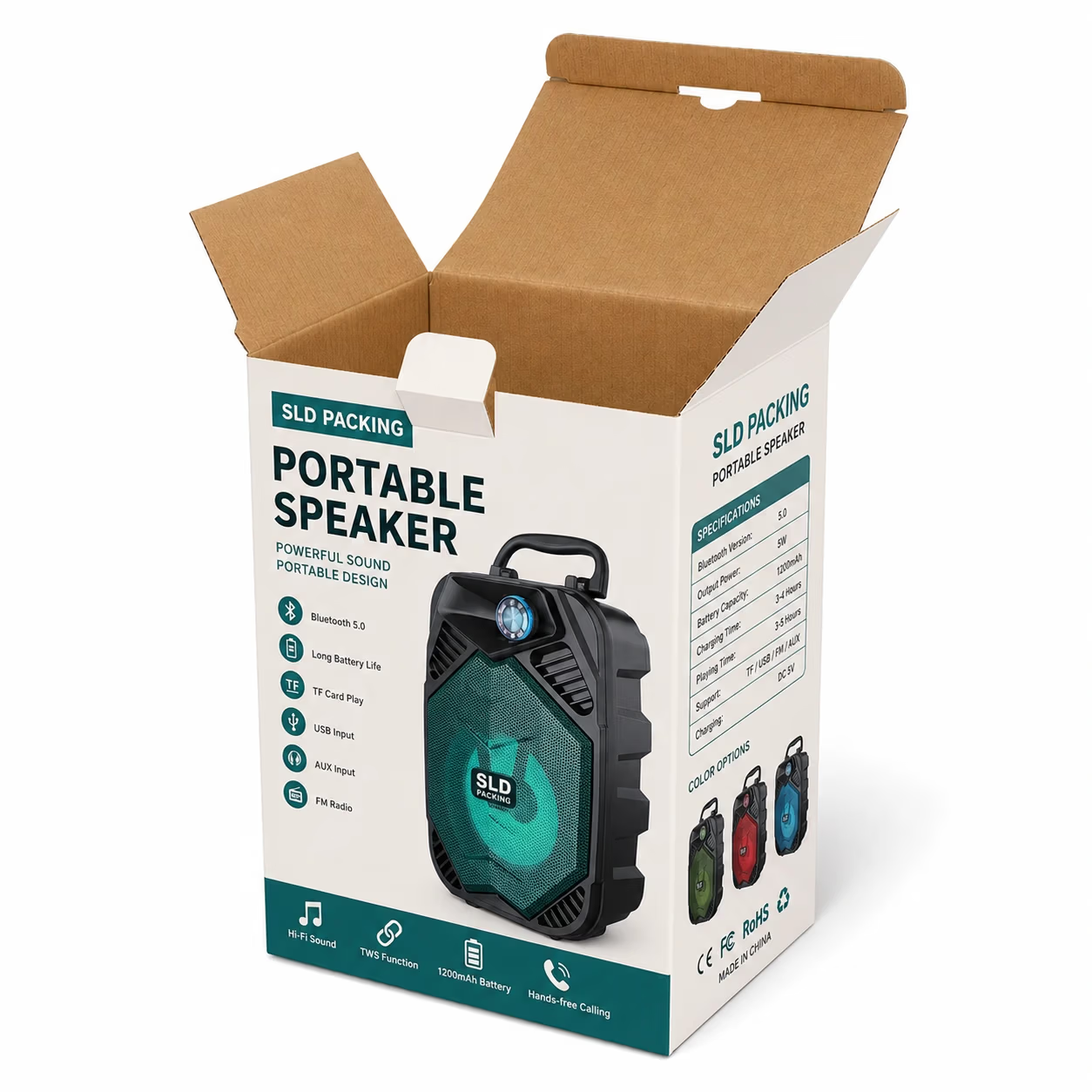
A tuck-top carton opens from one end. Its front panel can carry the main product image and model name, while a side panel can carry variant information, compatibility details or a barcode. It is a practical starting point for compact speakers, earbuds and lightweight headsets where shelf space and packing time matter. Folding versions can be supplied flat and erected at the packing station.
Specify the bottom separately. A tuck top tells you how the carton opens, and the bottom has its own job of supporting the load. Test that a loaded box can be picked up, set upright and stacked as intended. If the bottom flexes, revisit its construction and board. If a speaker handle pushes against the closed top flap, check the insert height and headroom. Compare folding carton options with the real packed weight in mind.
3. Book-style hinged-lid box
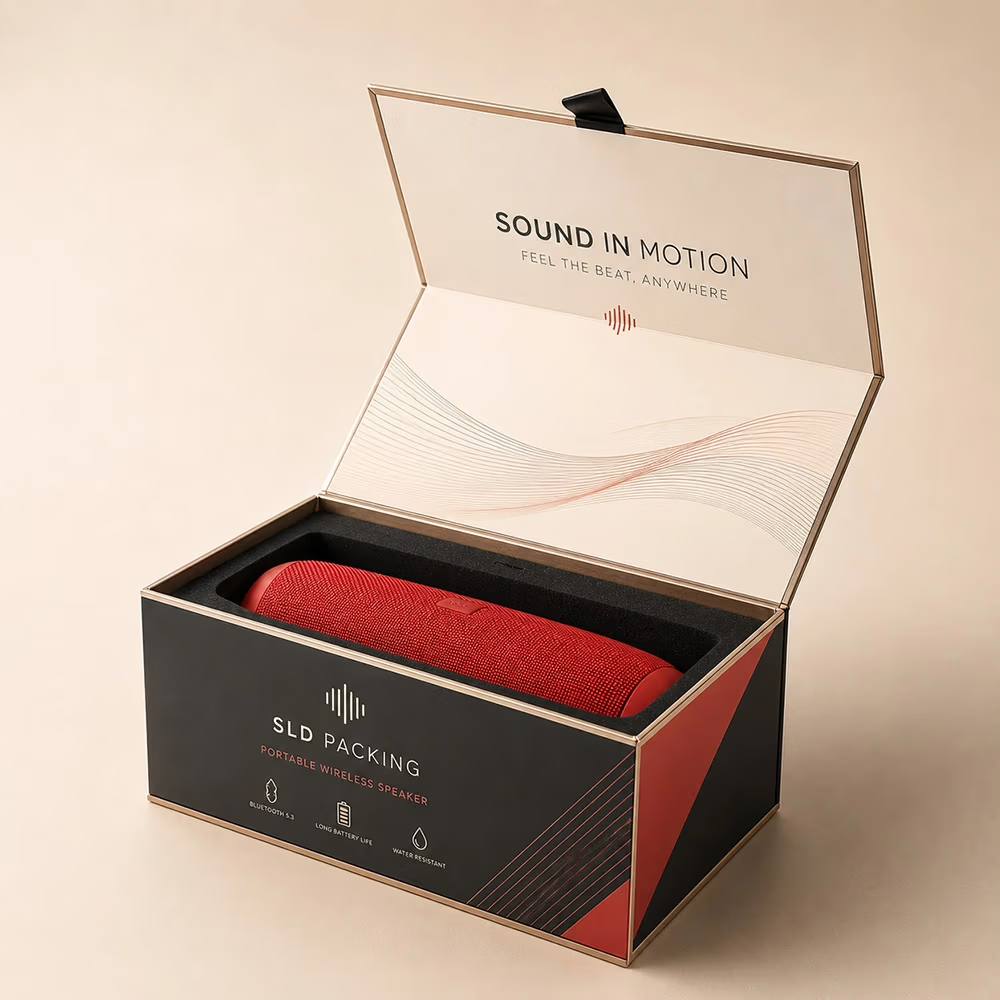
A book-style lid stays attached. That gives the inside cover a place in the opening sequence. A quick-start diagram can be visible while a speaker is still seated, or a launch message can appear as the customer opens a flagship headset. A magnetic closure is one option for a hinged rigid box.
Check the lid with the device and every accessory in place. A tall handle, an ear cup or a booklet near the hinge can interfere with the lid as it swings. Open the sample on the counter or table where it will be used, then check whether the customer can take out the product with both hands. If you need the lid to stay open for display, specify how it will be supported.
4. Drawer box with an outer sleeve
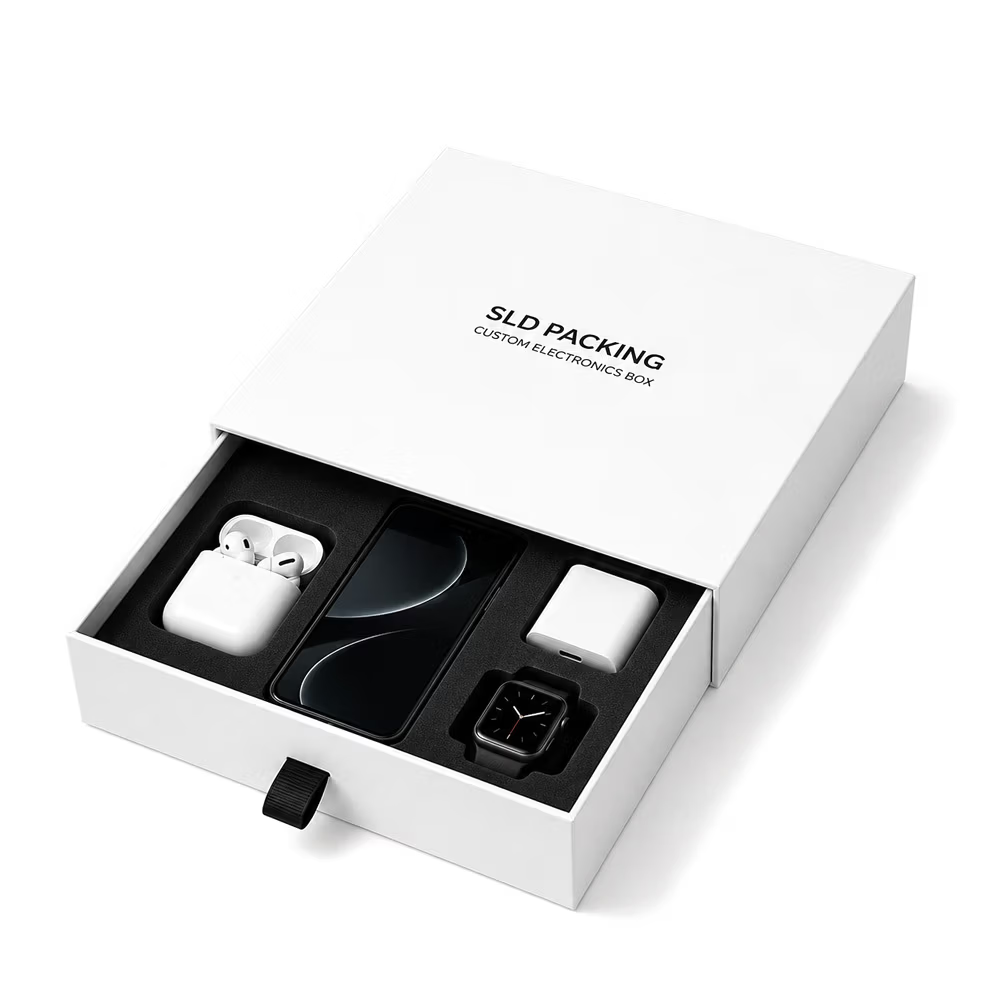
A drawer slides out along a sleeve. That suits earbuds with a charging case, a compact headset or a bundle where the main device can appear before the cable, tips or adapter. Decide which end the customer will pull and place the main item accordingly. The buyer also needs enough space in front of the box to extend the drawer.
Check how the loaded tray travels through the sleeve. A charging case or cable that sticks up above its recess can catch the upper edge, and an uneven load can make the drawer bind. Try pulling it by the tab from a normal grip. If the drawer is meant to stay attached when opened, specify a stop and check it with the full load. These details matter when specifying custom drawer boxes.
5. Corrugated mailer box
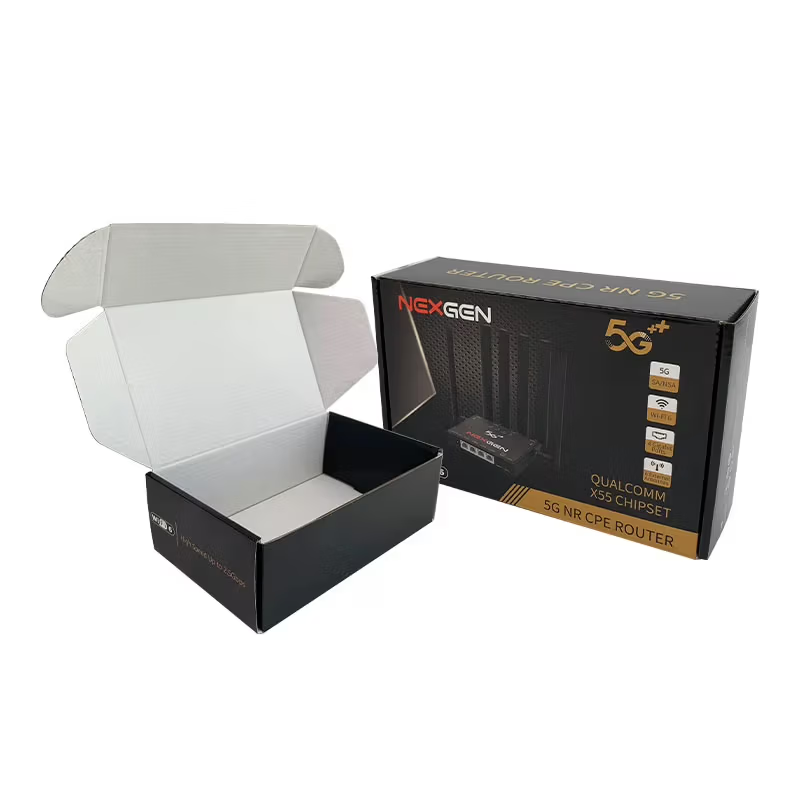
A corrugated mailer can serve as the parcel box for an audio device with its own fitted insert, or as an outer box around a separate retail pack. Compare those two configurations before setting the dimensions. A direct mailer needs to hold the device and its accessories in position. An overbox needs to hold the finished retail package and allow space for the specified cushioning. For both configurations, start by sizing the custom mailer box around the contents and protective components.
For a cylindrical speaker, check whether it can roll against an end panel. For headphones, check whether the folded ear cups can rotate or press against the lid. Choose the corrugated board, insert and closure for the packed weight and delivery route. If the box must ship on its own, validate the complete pack in its intended shipping configuration. ISTA’s guide to packaging design and testing explains how to select a test based on the distribution route and package type.
Check the device, insert and box together
- Measure the product in the position it will be packed. Include a speaker’s handle or feet, the folded headset’s widest point, or the earbuds’ charging case. Record maximum length, width, height and weight with units, plus the dimensions of the accessories.
- Agree where the insert should touch. Ask the product team which surfaces can carry load. Check sensitive areas such as speaker grilles, controls, ear cushions, hinges and glossy surfaces. Give chargers, plugs and spare tips their own space so they stay clear of the device.
- Run through the actual opening. Load the device, cables and literature, close the box, then unpack it in the intended order. Check finger access, flap or lid clearance and whether components have shifted. If there is an outer shipper, check the retail box inside it as well.
- Compare the packed configurations. Record the finished box dimensions, packed weight and any outer-carton dimensions. Include assembly and loading steps when comparing quotes. For transport testing, agree in advance which marks on the box and which changes in device function would count as failures.
For a structure recommendation, send SLD the device dimensions in its packed position, its weight, the accessory list, order quantity, sales channel and destination. If the new box will go around an existing retail pack, include its dimensions and packed weight. Product drawings or a sample help when the device has a handle, rotating ear cups or a fitted case. Discuss your audio packaging project with SLD Packing.